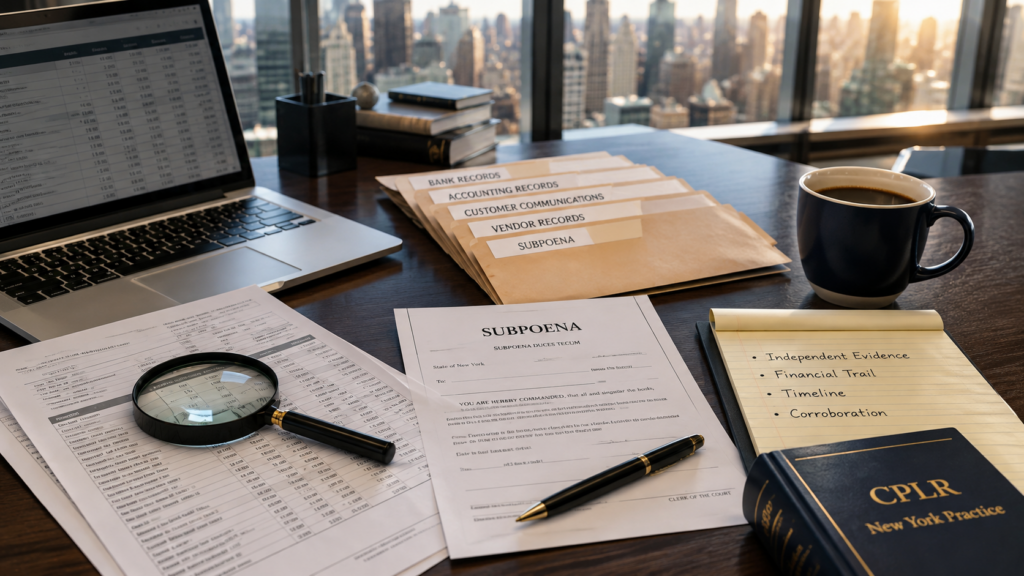
Sometimes the most important evidence is not held by either side, but by someone else. When parties in a business dispute think about discovery, they often assume that they can obtain evidence from the other party. Some of the most valuable documents in a business lawsuit are often in the possession of third parties, such as banks, accountants, vendors, customers, technology providers, or former employees. In many commercial disputes, a third-party subpoena can uncover critical evidence that neither side possesses or is willing to produce voluntarily. Used strategically, third-party discovery can fill evidentiary gaps, corroborate key facts, and significantly influence the outcome of a case.
What Is a Third-Party Subpoena?
A third-party subpoena is a legal mechanism that requires a person or business that is not a party to the lawsuit to produce documents, electronically stored information, or, in some cases, appear to testify. Unlike document requests served on the parties to the litigation, subpoenas allow attorneys to obtain relevant information from outside sources that may have knowledge of the underlying dispute or possess important records. In many business litigation matters, these third parties maintain records that provide a more complete picture of what occurred.
Who Can Receive a Third-Party Subpoena?
The answer depends on the facts of the case. Parties can serve a subpoena on virtually any individual or entity that possesses relevant, non-privileged information. In business litigation, this often includes financial institutions, accounting firms, customers, vendors, consultants, insurance companies, technology providers, landlords, former employees, and other businesses that participated in the underlying transaction or relationship.
For example, a bank may possess wire transfer records that trace the movement of corporate funds. An accountant may have financial statements that clarify damages. A vendor may have emails documenting negotiations or contract performance. A technology provider may retain electronically stored information that no longer exists on a company’s own servers.
What Types of Documents Can Be Requested?
The scope of a subpoena depends on the issues involved in the litigation, but third parties often possess valuable evidence that neither side can independently produce. This may include contracts, invoices, purchase orders, bank records, accounting files, financial statements, tax documents, emails, text messages, customer communications, audit reports, board materials, electronically stored information, and other business records maintained in the ordinary course of business. Because these documents existed before litigation began, they can provide objective evidence regarding what occurred and when it occurred.
Related Article:
Are There Limits on Third-Party Discovery?
Yes. Although discovery in New York is broad, third-party subpoenas are not unlimited. The requested information must generally be relevant to the claims or defenses in the lawsuit, and courts may limit requests that are overly broad, unduly burdensome, or seek privileged information.
Likewise, a third party is not required to produce documents protected by the attorney-client privilege or other recognized legal protections. When disputes arise regarding the scope of a subpoena, the court may be asked to determine whether the requested information should be produced.
Why Third-Party Discovery Can Be So Powerful
Third-party documents frequently carry significant evidentiary value because they come from a source that is not directly involved in the litigation. Records maintained by banks, accountants, customers, and other independent entities often corroborate or contradict the parties’ positions. In some cases, a single third-party document can reshape the litigation by confirming the timing of a transaction, identifying who approved a decision, tracing financial activity, or disproving a party’s version of events. Because these records are created independently of the lawsuit, they are often viewed as particularly reliable evidence.
Timing Is Critical
Third-party discovery should not be an afterthought. Court-established discovery deadlines govern business litigation. Waiting too long to identify key third parties can make it more difficult to obtain documents, schedule testimony, or incorporate the evidence into the overall litigation strategy. Developing a comprehensive discovery plan early in the case allows attorneys to identify potential sources of evidence before opportunities are lost.
An Effective Discovery Strategy Looks Beyond the Parties
Successful business litigation is built on uncovering the complete factual record. Sometimes that evidence comes from the opposing party. Other times, it comes from individuals or businesses that have no stake in the outcome of the lawsuit but possess information that is essential to proving the case.
At Alisme Law, we represent businesses, shareholders, partners, and executives in complex commercial disputes throughout New York. We develop strategic discovery plans that include identifying, preserving, and obtaining relevant evidence from third parties whenever doing so advances our clients’ interests.
Contact us to schedule a confidential case evaluation at 917-540-8432.
This article is for informational purposes only and does not constitute legal advice.