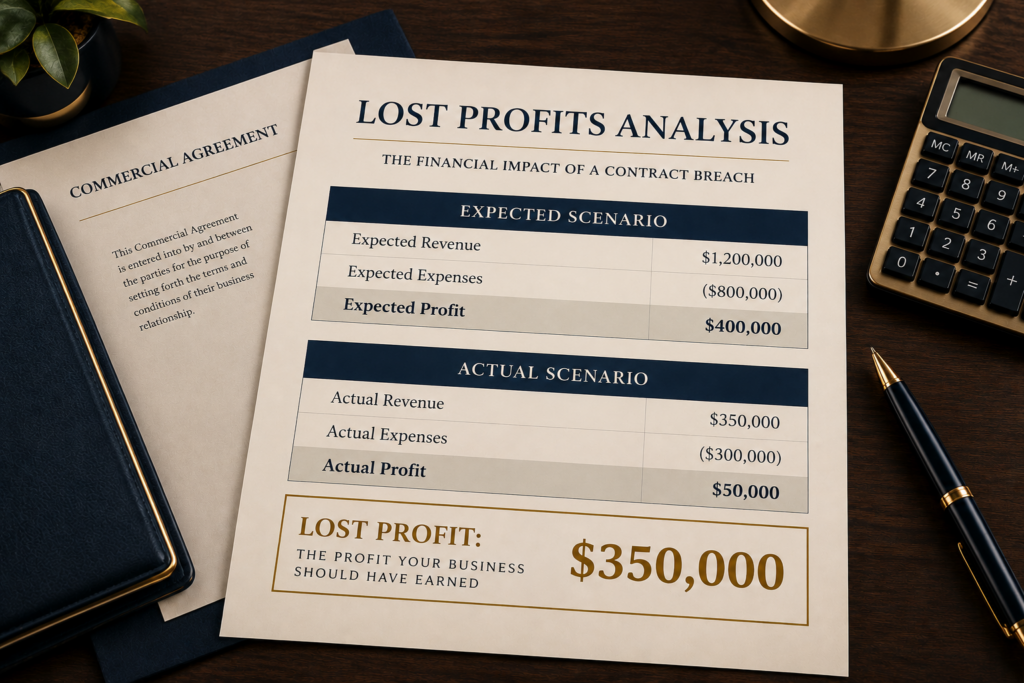
The value of a contract lawsuit may extend far beyond the amount of an unpaid invoice. When one company breaches a contract, the financial consequences for the other business may extend beyond the money immediately owed under the agreement. A supplier’s failure to deliver critical materials may prevent a company from completing orders for its own customers. A distributor’s breach of an exclusivity agreement may divert sales to a competitor. A contractor’s failure to complete a project may delay the opening of a new location. Or the premature termination of a long-term commercial agreement may eliminate revenue the business expected to earn for years.
In those situations, the business may believe the real loss is not simply what it was owed under the contract, but the profit it would have earned if the other side had performed under the agreement. Lost profits are potentially recoverable as damages in a breach-of-contract action. But claiming that a breach cost your business future revenue is much easier than proving what those profits would have been.
Contract Damages Are Intended to Address the Loss Caused by the Breach
The basic purpose of damages in a breach-of-contract case is generally to compensate the nonbreaching party for losses caused by the other side’s failure to perform. Sometimes that calculation is relatively straightforward. If a customer received $100,000 worth of services and failed to pay the invoice, the unpaid amount may form the central component of the damages claim.
Other breaches create consequences that extend beyond an outstanding payment. Suppose a manufacturer agrees to provide a retailer with 10,000 units of a product before the holiday shopping season. The manufacturer fails to deliver, and the retailer cannot fulfill customer orders it reasonably expected to receive.
The retailer’s potential damages may involve more than amounts exchanged between the retailer and manufacturer. The retailer may contend that the breach caused it to lose profits from sales it otherwise would have made. That introduces a more complicated damages analysis.
Lost Revenue and Lost Profits Are Not the Same Thing
A business claiming lost profits should distinguish between revenue it expected to receive and profits it expected to earn. Suppose a business can establish that a breach caused it to lose $1 million in expected sales. That does not necessarily mean it lost $1 million in profits.
Generating those sales may have required the company to incur substantial expenses. Materials, commissions, shipping, labor, and other costs might have been necessary to produce that revenue. If the company would have spent $700,000 generating the $1 million in sales, the economic loss associated with the expected profits may look very different from the gross revenue figure. Financial records and the company’s cost structure can therefore become critical when calculating a lost-profits claim.
The Lost Profits Must Be Connected to the Breach
A business must do more than show that profits declined after the other side breached the agreement. The breach must be sufficiently connected to the claimed loss. That distinction matters when other events affected the business at the same time.
A company’s sales may have declined because of changing market conditions, the loss of an unrelated customer, increased competition, supply-chain problems, internal management issues, or other factors independent of the defendant’s conduct. The parties may therefore dispute what caused the lost profits.
The business pursuing the claim may contend that the breach disrupted a profitable operation. The defendant may argue that the company would have experienced the same losses regardless of the alleged breach. Sales records, customer communications, historical performance, market data, internal forecasts, and expert analysis can become important evidence in resolving that dispute.
The Loss Must Have Been Reasonably Foreseeable
Not every financial consequence of a breach is necessarily recoverable. Lost-profit claims can involve whether the type of loss was reasonably within the contemplation of the parties when they entered the agreement. The circumstances surrounding the contract can matter.
If a supplier knows its product is necessary for the buyer to fulfill a specific customer contract, the consequences of failing to deliver may differ from a situation where the supplier had no reason to know how its product would be used. Contracts themselves may also describe the purpose of the relationship, the anticipated use of goods or services, or other circumstances relevant to what the parties understood when they agreed. This can make the parties’ communications before and during the contractual relationship particularly important.
Lost Profits Cannot Be Based Entirely on Speculation
One of the central challenges in a lost-profits claim is proving the amount of the loss with sufficient certainty. Future business performance is never completely predictable. Courts therefore do not simply accept a company’s assertion that it expected to earn a particular amount. The claim should be supported by evidence.
For an established business, historical performance can be particularly useful. Prior sales, profit margins, recurring customer orders, existing contracts, seasonal trends, and financial statements may provide a basis for estimating what the business likely would have earned. The more closely the claimed profits are tied to actual business performance, the stronger the evidentiary foundation may be.
Lost Profits for a New or Growing Business
Lost-profits claims can become more difficult when the business or business venture has little operating history. A new company may not have several years of sales data showing what it typically earns, as it may never have sold a product before or may have failed to open a new location. That does not necessarily mean lost profits are impossible to establish. But the business may need other evidence to show the claimed profits are grounded in more than optimism.
Existing customer contracts, purchase orders, preorders, performance at comparable locations, market data, documented sales pipelines, and other objective evidence may become particularly important. The central question remains whether the aggrieved party can establish its case with reasonable certainty rather than speculation.
The Contract May Limit Lost-Profit Damages
Before assuming lost profits are recoverable, review the contract carefully. Commercial agreements frequently contain provisions limiting the types or amounts of damages that a party can recover if something goes wrong. A contract may exclude consequential damages, specifically prohibit recovery of lost profits, impose a damages cap, or limit liability to amounts paid under the agreement.
Those provisions can significantly affect the economics of a breach-of-contract lawsuit. Their application can also become disputed. The parties may disagree over whether a particular limitation applies to the breach at issue, whether lost profits constitute the type of damages excluded by the agreement, or whether another contractual provision affects the limitation. The damages provisions should therefore be evaluated early when assessing the potential value of a contract claim.
Evidence Can Determine the Value of the Claim
Lost-profits cases often depend heavily on financial evidence. Tax returns, profit-and-loss statements, invoices, sales reports, customer contracts, purchase orders, budgets, forecasts, and accounting records can all become relevant. Communications may matter as well. Emails with customers can establish expected purchases. Internal records may show projected demand. Communications between the contracting parties may demonstrate what each side understood about the purpose and financial importance of the agreement.
In cases involving substantial claimed losses, financial or economic experts may also analyze the company’s records and calculate the profits the business allegedly would have earned but for the breach. A lost-profits claim is therefore not simply about identifying a large number. It is about building an evidentiary record that supports that number.
Evaluating Lost Profits in a Breach-of-Contract Case
When a party breaches a commercial agreement, determining the value of the claim requires looking beyond the most obvious loss. The business should consider what profits it expected to earn, whether the breach caused those profits to be lost, whether the loss was reasonably foreseeable, whether it can establish the amount with sufficient certainty, and whether the contract limits available damages. Those questions can substantially affect both litigation strategy and settlement negotiations.
At Alisme Law, we represent businesses in breach-of-contract and commercial litigation throughout New York. When a contractual breach causes significant financial harm, we help our clients evaluate the damages, identify the evidence needed to support those damages, and develop a litigation strategy designed to protect their business interests.
Contact us to schedule a confidential case evaluation at 917-540-8432.
This article is for informational purposes only and does not constitute legal advice.