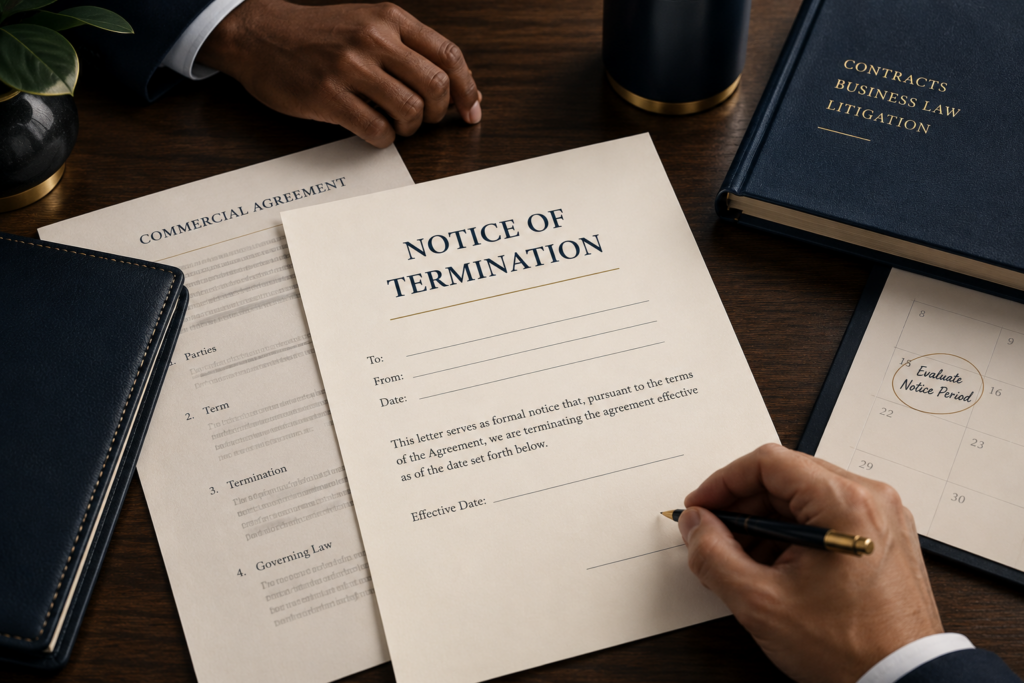
A breach may give your business the right to terminate a contract. But ending the relationship in the wrong manner can create a second dispute. When another company breaches an important business agreement, continuing the relationship may no longer make sense. A vendor may repeatedly fail to deliver, or a customer may stop making required payments. Similarly, a contractor may abandon a project, a distributor may violate an exclusivity provision or a business partner to a commercial agreement may fail to satisfy an obligation that was central to the deal. The natural response in such situations may be to terminate the contract.
But a breach does not necessarily give a business an immediate right to terminate. The contract may require formal notice. The other side may have a specified period to cure the default. The breach may need to be sufficiently material to justify termination. And even after the agreement is terminated, certain contractual obligations may remain in effect. Getting those issues wrong can transform a legitimate breach-of-contract claim into a lawsuit over whether the termination itself violated the agreement.
The Contract Is the Starting Point
Before terminating a commercial contract, start with the contract itself. Well-drafted business agreements frequently specify when and how the parties can terminate the relationship. Those provisions may identify events that constitute grounds for termination, establish procedures the parties must follow, and explain what happens once termination becomes effective. The language matters.
A contract might permit immediate termination for certain serious violations while requiring notice and an opportunity to cure other defaults. Another agreement might allow termination without cause but require 30, 60, or 90 days’ advance notice. A company should therefore understand the termination rights it negotiated before deciding that the other side’s breach has ended the agreement.
Termination for Cause
Many commercial agreements allow a party to terminate for cause when the other side fails to satisfy specified contractual obligations. The agreement itself may define what constitutes cause. Nonpayment, insolvency, loss of a required license, misuse of confidential information, violation of exclusivity obligations, or repeated failures to perform may be specifically identified as grounds for termination.
When the contract defines the circumstances permitting termination, whether the alleged breach falls within those provisions can become an important issue. As such, the nonbreaching party must identify the provision the other side violated and the provision that gives it the right to end the agreement as a result.
The Breach May Need to Be Material
When the contract does not expressly give a party the right to terminate for a particular violation, the seriousness of the breach can become especially important. Not every failure to perform necessarily permits the other side to end the contractual relationship. A relatively minor breach may support a claim for damages while leaving the remainder of the agreement in place. A material breach, however, may be serious enough to excuse the non-breaching party from further performance and support termination. The distinction can be highly fact specific.
A missed deadline that has little practical consequence may be treated differently from a failure that defeats the central purpose of the agreement. Similarly, a small payment discrepancy may present a different issue from a party refusing to make substantial payments that form the core consideration for the contract. In litigation, the parties may disagree sharply over whether the breach was serious enough to justify termination.
Notice Requirements Matter
Even when a business has grounds to terminate, the contract may prescribe exactly the method and time of notice to the other party. A termination provision might require written notice to a particular person or address. It may specify delivery by certified mail, overnight delivery, email, or another method. It may also require the notice to identify the default or contractual provision at issue.
These requirements can seem procedural when the business relationship is already deteriorating. But once litigation begins, they can become substantive. The breaching party may argue that the termination was ineffective because the required notice was never provided or because the company failed to follow the agreed procedure. A casual email saying that the relationship is over may not necessarily satisfy a detailed contractual notice provision.
Cure Periods Can Delay the Right to Terminate
Many contracts give a defaulting party time to fix the problem before termination becomes available. For example, an agreement might require written notice of a payment default and give the defaulting party ten days to make the required payment. Another contract might provide 30 days to cure a failure to perform. The cure period can serve an important commercial purpose. It allows the parties to resolve a problem before terminating an ongoing business relationship.
But it also creates a potential trap. If the contract requires notice and an opportunity to cure, terminating before that period expires may violate the agreement even if the other side initially breached it. Whether a breach is curable can also become disputed. Some violations can readily be corrected, while others may cause irreparable harm. The language of the agreement and the nature of the breach therefore both matters.
Termination for Cause and Termination Without Cause
Commercial agreements sometimes provide more than one route for ending the relationship. A business may have the right to terminate for cause when the other party breaches. It may separately have the right to terminate without cause upon sufficient advance notice. Those alternatives can create strategic decisions. If the grounds for a for-cause termination are disputed, a company may need to evaluate the risks associated with relying on that provision. A without-cause termination provision may provide another route, but it may require a longer notice period or trigger different financial consequences. The appropriate approach depends on the agreement, the facts, and the company’s objectives.
Obligations That Continue After Termination
Ending a contract does not necessarily end every obligation contained in it. Commercial agreements frequently include provisions that expressly survive termination. Confidentiality obligations may continue. Restrictions concerning intellectual property or proprietary information may remain enforceable. Outstanding invoices may still need to be paid. Some agreements also contain restrictive covenants, indemnification provisions, dispute-resolution requirements, or attorneys’ fee provisions that continue after the business relationship ends. A company preparing to terminate should therefore consider not only whether it can terminate, but also what it must do afterward.
Terminating a Business Contract Strategically
When the other side breaches a commercial agreement, termination may be the appropriate response. But a breach is only the beginning of the analysis. The business should understand its contractual termination rights, determine whether the breach is sufficiently serious, comply with notice and cure requirements, preserve the evidence supporting its position, and account for obligations that survive termination. Those steps are especially important when the contract involves substantial revenue, an important commercial relationship, valuable intellectual property, or significant future obligations.
At Alisme Law, we represent businesses in breach-of-contract and commercial litigation throughout New York. When a contractual relationship breaks down, we help our clients evaluate their rights, determine whether termination is legally and strategically appropriate, and develop a litigation strategy designed to protect their business interests.
Contact us to schedule a confidential case evaluation at 917-540-8432.
This article is for informational purposes only and does not constitute legal advice.