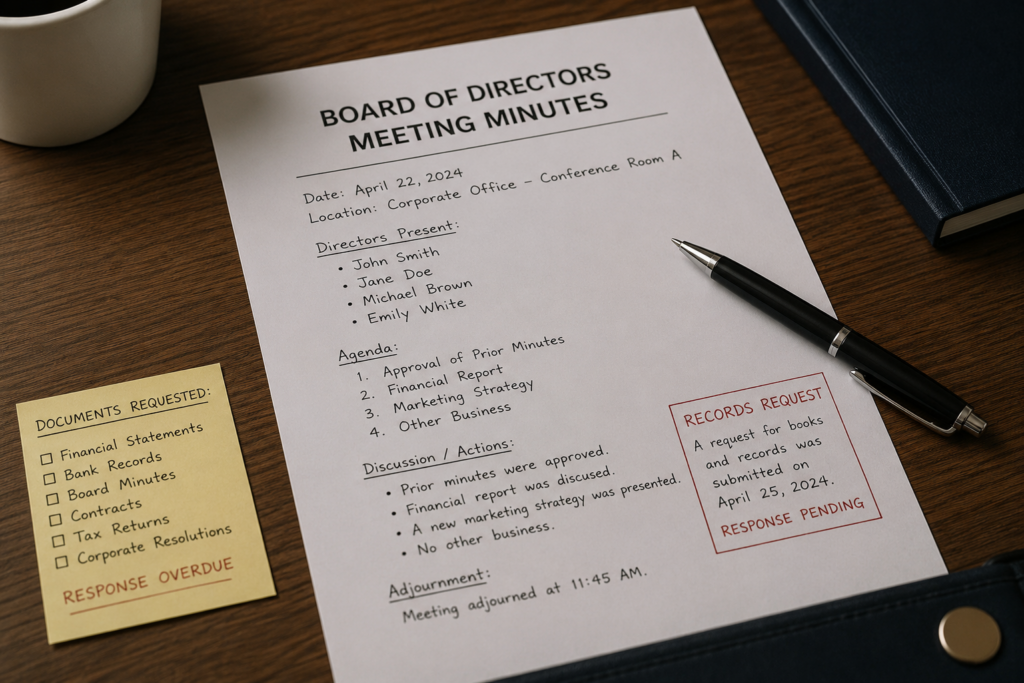
Board disputes rarely begin with a lawsuit. More often, they begin with subtle changes in how a company is governed by one of the following occurrences, among others: (1) the board excludes a member from important discussions, (2) a member is unable to obtain financial information, (3) one or two members make decisions without proper approval, (4) or meeting minutes become incomplete, inconsistent, or unavailable. Individually, these issues may appear manageable. Collectively, they may signal that the relationship among the company’s leaders is beginning to break down.
Not every governance problem results in litigation. However, recognizing warning signs early can help businesses, directors, officers, and shareholders evaluate their options before disagreements become entrenched and more difficult to resolve.
1. Major Decisions Are Made Without Proper Approval
Corporate governance rules exist to ensure that significant business decisions are made through the proper decision-making process. When directors, officers, managers, or controlling shareholders begin acting unilaterally without the approvals required by the company’s governing documents or applicable law, disputes often follow.
Examples may include approving major transactions without board authorization, entering into significant contracts without the required approval, changing compensation or distributions, taking on debt, selling company assets, issuing ownership interests, or making material financial decisions outside the company’s established governance structure. When authority is exercised outside the proper channels, questions may arise about whether those decisions were valid, whether fiduciary duties were breached, and whether the company or its owners were harmed.
2. Directors Are Excluded From Key Discussions
Healthy corporate governance depends on informed participation. When directors stop receiving meeting notices, are excluded from discussions about significant company decisions, or are denied access to information necessary to fulfill their responsibilities, governance problems often emerge.
Disagreements among directors are common. However, intentionally preventing a director from participating in the governance process may create issues that extend beyond ordinary business disagreements. Exclusion from board communications, informal decision-making outside properly noticed meetings, or selective sharing of information can become evidence of a deeper dispute over control, authority, or fiduciary obligations.
3. Financial Transparency Starts to Disappear
One of the earliest indicators of a governance dispute is a decline in financial transparency. Directors or shareholders may find it increasingly difficult to obtain financial statements, accounting records, budgets, bank records, tax information, payroll records, or other materials needed to understand how the business is operating.
Requests for information may be delayed, ignored, or met with incomplete responses. Accounting practices may change without explanation. Bank access may be restricted. Financial reports may become less detailed or stop being provided altogether. A lack of transparency does not necessarily establish wrongdoing. However, when directors, shareholders, or business owners are unable to obtain basic financial information, it often raises questions that deserve careful review.
4. Conflicts of Interest Are Not Disclosed
Directors and officers owe duties to the corporation. When individuals involved in managing the company place their personal interests ahead of the company’s, governance disputes can escalate quickly. Potential warning signs may include related-party transactions, undisclosed financial interests, compensation decisions that benefit insiders, competing business ventures, the diversion of customers or business opportunities, or contracts awarded to companies affiliated with directors, officers, or controlling shareholders.
Not every conflict of interest results in liability. In many situations, conflicts can be disclosed, evaluated, and properly managed. The failure to disclose or address those conflicts, however, can significantly increase the risk of shareholder, director, or corporate-control litigation.
5. Corporate Decisions Are Poorly Documented
Good corporate governance depends on accurate documentation. Board resolutions, meeting minutes, written consents, ownership records, notices, approvals, and corporate books and records help show how decisions were made and whether proper procedures were followed.
When important decisions are undocumented, meeting minutes are inconsistent, written consents are missing, or corporate records are incomplete, uncertainty often follows. In litigation, the absence of documentation can become just as important as the documents that exist.
Poor documentation may make it harder to determine who approved a transaction, whether notice was properly given, whether a director objected, or whether the company followed its own governing documents. Those gaps can become central issues in a governance dispute.
Governance Issues Rarely Resolve Themselves
Corporate governance disputes rarely develop overnight. They often begin with small departures from established practices before evolving into more significant disagreements involving fiduciary duties, shareholder rights, board authority, financial transparency, or corporate control. Addressing these issues early may help preserve business relationships, clarify responsibilities, protect company records, and position the parties to evaluate their legal options if litigation becomes necessary.
At Alisme Law, we represent businesses, shareholders, directors, and officers in corporate governance and shareholder disputes involving board authority, fiduciary duties, shareholder rights, financial transparency, and corporate control. If you are being excluded from key decisions, denied access to company information, concerned about conflicts of interest, or facing a dispute over control of a business, contact us to schedule a confidential case evaluation: 917-540-8432.
This article is for informational purposes only and does not constitute legal advice.