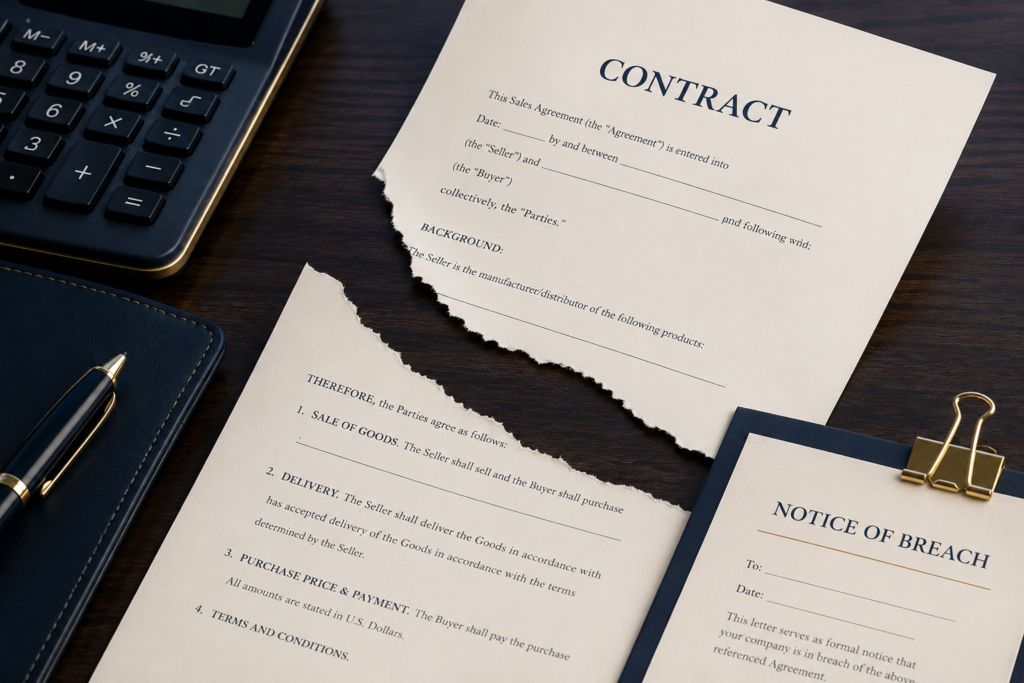
When the other side breaks the deal, your business cannot always just walk away. A business contract usually creates obligations for both sides. One party may be required to provide services, deliver goods, meet certain deadlines, or complete specified work. The contract may require the other side to make payments, provide information, approve deliverables, or perform other obligations necessary for the relationship to continue.
When one side fails to do what the contract requires, the other party may understandably believe it no longer has to perform either. But that can be a dangerous assumption. Not every breach of contract gives the non-breaching party the right to stop performing. Depending on the seriousness of the breach, the language of the agreement, and what happens after the breach, a business that stops performing too quickly can find itself accused of breaching the same contract it originally sought to enforce.
The Difference Between a Material Breach and a Minor Breach
One of the first issues is whether the other party’s breach is material. A material breach is generally one that is sufficiently significant to undermine the agreement and may excuse further performance by the non-breaching party. A relatively minor failure, by contrast, may give rise to a claim for damages without necessarily allowing the other party to abandon its own contractual obligations.
Consider a company that hires a software developer to build a business-critical platform by a specific launch date. If the developer misses the deadline by several months and has completed only a fraction of the promised work, the customer may have a very different argument than if the developer delivers the completed platform one day late.
Both situations may involve a failure to comply with the contract. But the consequences of those failures are not necessarily the same. The nature of the obligation, the extent of the failure, the purpose of the contract, and the effect of the breach on the parties’ bargain can all become important.
Continued Performance After a Breach
Businesses often continue working together even after one side has breached the agreement. Practical reasons may drive this. A company may need the relationship to continue while it identifies another vendor. The parties may be trying to resolve their disagreement. The non-breaching party may want to minimize its losses rather than immediately terminate a valuable contract. Continuing to perform does not necessarily mean that a business has surrendered every claim arising from the breach.
But what the business says and does after learning of the breach can matter. If a company continues accepting performance for months, continues making payments, or repeatedly treats the agreement as remaining in effect, the other side may later argue that the company waived certain objections or elected to continue the contractual relationship. That makes the response to a breach an important part of the litigation strategy, not merely a business decision.
The Contract’s Termination Rights Matter
Before stopping performance, carefully review the agreement. Many commercial contracts specify circumstances under which one party may suspend performance or terminate the relationship. The agreement may distinguish between termination for cause and termination without cause. It may identify particular defaults that permit termination or establish different procedures depending on the type of breach.
The contract may also address what happens after termination. Outstanding payments may become due. Confidentiality provisions may survive. Property may need to be returned. Intellectual property rights may change. The parties may have continuing obligations even though their primary business relationship has ended. A business should therefore be cautious about assuming that the existence of a breach automatically gives it an unrestricted right to stop everything it is required to do.
Notice Requirements Can Affect Your Rights
Commercial contracts frequently contain specific notice provisions. The agreement may require written notice of a breach before the non-breaching party can exercise certain remedies. It may specify where a party must send notice, how it must be delivered, and what information it must contain.
Those requirements can appear technical, but they can become significant once litigation begins. A frustrated executive may believe that an email saying, “You have not delivered what you promised,” clearly informed the other side of the problem. The contract, however, may require formal written notice sent to a particular address and identifying the breached contractual provision.
Whether the parties complied with contractual notice requirements can become an important issue in determining the justifiability of that party’s later actions.
Cure Provisions May Require an Opportunity to Fix the Breach
Some contracts require a party to be allowed to cure a default before the other side may terminate the agreement or exercise other remedies. For example, an agreement might provide that a party has 10 or 30 days after receiving notice to correct a particular breach. If the breaching party fixes the problem within that period, the non-breaching party may not have the right to terminate based on that default.
A business that ignores a contractual cure provision and immediately stops performing may create an entirely new dispute about whether its own actions violated the agreement. This is one reason a company should review the contract before, not after, deciding how to respond.
Waiver Can Complicate an Otherwise Strong Breach Claim
Business relationships rarely operate with perfect contractual compliance. A customer may routinely accept late deliveries. A vendor may repeatedly accept payments after the contractual due date. One side may overlook reporting requirements or other technical obligations for years. That history can become important when the relationship deteriorates.
If a business repeatedly accepts conduct that does not strictly comply with the agreement, the other side may argue that the business waived strict compliance with that particular requirement. Many contracts contain provisions stating that a failure to enforce a contractual right does not constitute a waiver. But even then, the parties’ actual conduct and communications can become important when a dispute arises. A company confronting a breach should therefore consider not only what the contract says, but also how the parties have actually performed under it.
The Risk of Becoming the Breaching Party
The greatest danger in stopping performance is that the legal positions of the parties can change. Imagine that Company A believes Company B breached their agreement. Company A immediately terminates the relationship, stops making payments, and refuses to perform any remaining obligations. Company B responds that its alleged breach was minor, that the contract required notice and an opportunity to cure, and that Company A had no contractual right to terminate.
The lawsuit may then involve competing breach-of-contract claims. Instead of simply proving that Company B failed to perform, Company A may also have to defend its own decision to stop performing. That can affect damages, defenses, settlement leverage, and the overall litigation strategy. In many contract cases, the critical question is therefore not simply whether a breach occurred, but what the non-breaching party was legally entitled to do next.
Responding Strategically to a Breach of Contract
When another party breaches an important business contract, the immediate reaction may be to stop performing and end the relationship. Sometimes that is exactly what the contract and the law permit. Other times, the business may need to provide notice, allow an opportunity to cure, continue certain obligations, reserve its rights, or take other steps before terminating performance. The decision can become particularly important when substantial money, an ongoing business relationship, or significant future obligations are involved.
At Alisme Law, we represent businesses in breach-of-contract and commercial litigation throughout New York. When a contractual relationship breaks down, we help our clients evaluate the agreement, determine the significance of the other party’s breach, understand their available remedies, and develop a litigation strategy that advances their business objectives.
Contact us to schedule a confidential case evaluation at 917-540-8432.
This article is for informational purposes only and does not constitute legal advice.