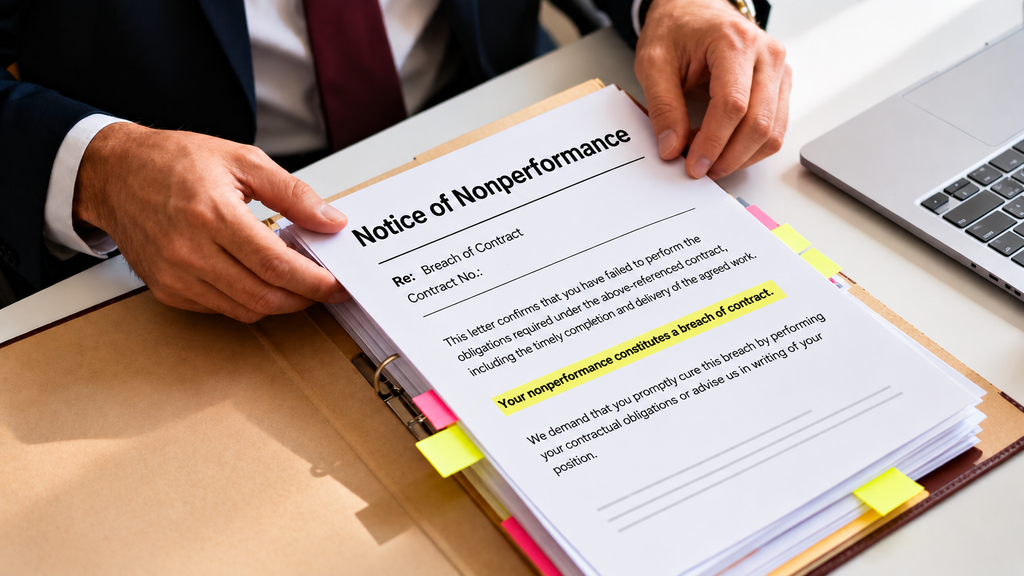
Your business completes a substantial project, delivers the agreed services, or supplies products to a customer. You send the invoice expecting payment under the agreed terms. But the deadline passes, and the money never arrives. At first, the customer promises to pay soon, then the explanations change. They question the work, dispute the invoice, or stop responding altogether. Meanwhile, your business has already incurred expenses, committed resources, and fulfilled what it understood to be its contractual obligations.
When does an unpaid invoice become a breach of contract? Under New York law, a refusal to pay may give rise to a breach of contract claim when an enforceable agreement requires payment and the other party fails to satisfy that obligation. But whether your business can recover depends on the contract’s terms, your company’s performance, the reasons payment was withheld, and the damages resulting from the breach.
An Unpaid Invoice Is Not Automatically a Breach of Contract
An unpaid invoice may show a contractual dispute, but the invoice alone does not necessarily establish that the customer breached an agreement. The critical question is whether the parties had an enforceable contract requiring payment and whether the payment obligation became due.
For example, a consulting company may agree to provide services for $25,000 per month, payable within 30 days of invoicing. If the company performs the agreed services and the customer fails to pay by the contractual deadline, that failure may constitute a breach. However, if payment depended on completing specified milestones or obtaining approval, the company may first need to show those conditions were satisfied or excused. Businesses should review the agreement, payment provisions, invoices, and communications before deciding whether nonpayment supports a legal claim.
Payment Deadlines and Contract Terms Matter
Many commercial agreements specify when payment is due, whether invoices require approval, and what happens if payment is late. These provisions can determine when a payment obligation becomes enforceable and whether nonpayment constitutes a breach.
A contract may require payment upon delivery, within 30 days of an invoice, or after completion of a particular phase of work. It may also provide for late charges, contractual interest, notice of default, or an opportunity to cure before certain remedies become available. Where the agreement does not clearly establish a payment deadline, the parties’ communications, prior dealings, and applicable law may become important. A customer cannot necessarily avoid payment simply by refusing to acknowledge an invoice. At the same time, a business pursuing recovery must establish that the amount demanded is actually due under the parties’ agreement.
Claims of Defective or Incomplete Work May Complicate Payment
One of the most common defenses to a payment claim is that the business seeking payment failed to perform its own contractual obligations. A customer may allege that services were incomplete, products were defective, or the work did not satisfy agreed specifications. Depending on the contract and the seriousness of the alleged deficiencies, those claims may provide a basis to dispute payment, seek damages, or assert counterclaims.
But not every complaint justifies withholding the entire contract balance. Under New York law, the distinction between substantial performance and a material breach can be significant, particularly in service and construction-related disputes. A business that substantially performed may, depending on the circumstances, be entitled to payment subject to an appropriate deduction for deficiencies. The outcome often depends on the contract’s language, the nature of the alleged defects, whether the customer accepted the work, and whether the deficiencies were sufficiently serious to excuse payment.
Withholding Payment as Leverage Can Create Legal Exposure
Sometimes a customer refuses to pay not because the work was defective, but because it wants to renegotiate the agreement, obtain additional services, or pressure the other party into accepting a discount. For example, a company may acknowledge receiving the contracted services but insist on a lower price after the work is complete. Another customer may threaten to withhold an outstanding balance unless the vendor agrees to unrelated concessions.
A party generally cannot unilaterally rewrite an enforceable contract simply because the agreed terms have become inconvenient. If payment is due and no valid contractual or legal justification exists for withholding it, the refusal may constitute a breach. However, the business seeking payment should still consider whether the customer has legitimate contractual defenses, setoff rights, or counterclaims. A payment dispute can involve obligations on both sides, and those issues may affect the amount ultimately recoverable.
Evidence Is Essential to Proving a Payment Breach
A business pursuing unpaid contractual amounts generally must establish an enforceable agreement, its own performance or an applicable excuse, the other party’s breach, and resulting damages. The contract, purchase orders, invoices, delivery confirmations, payment history, and correspondence may help establish those elements. Emails acknowledging the outstanding balance, promises to pay, or communications confirming acceptance of the work can be particularly significant.
For example, if a customer repeatedly promises to pay an overdue $150,000 invoice without disputing the underlying services, those communications may support the business’s position that payment was required and remained outstanding. Conversely, contemporaneous complaints about performance may become central to the customer’s defense. Preserving these records before litigation begins can help establish what was agreed to, whether the business performed, and why payment was withheld.
Your Business May Recover More Than the Unpaid Balance
When nonpayment constitutes a breach of contract, the business may seek damages intended to compensate it for the loss resulting from the breach. In a straightforward payment dispute, those damages often include the unpaid contractual amount, subject to applicable defenses and offsets.
Additional recovery may be available depending on the agreement and governing law. New York law may permit prejudgment interest on certain contract damages, while an enforceable contractual provision may establish a different applicable interest rate. Attorneys’ fees generally are not recoverable merely because a business prevails in litigation; a contractual provision, statute, or recognized exception must authorize them. A customer may also assert counterclaims alleging defective work, delays, or other contractual violations. Those claims can affect the dispute’s value and complexity, so it’s important to evaluate potential recovery alongside anticipated defenses and litigation costs.
Litigation May Be Necessary to Enforce Payment Obligations
When repeated payment requests fail, a business may need to consider litigation to enforce its contractual rights. This is particularly true when the unpaid balance is substantial, the customer disputes liability, or the refusal to pay threatens the company’s financial interests. A breach of contract lawsuit may allow the business to pursue the outstanding balance, applicable interest, and other recoverable damages. Discovery can also help establish the parties’ contractual obligations, examine the customer’s reasons for withholding payment, and obtain evidence relevant to disputed performance.
Depending on the circumstances, additional legal theories may be available. For example, an action on an account stated may be considered where invoices were received and retained without timely objection under circumstances supporting an agreement as to the balance due. That claim has separate requirements and does not automatically arise from sending an invoice. Litigation is not always necessary, but when the other party refuses to honor an enforceable payment obligation, pursuing legal remedies may be essential to protecting the business’s interests.
A Refusal to Pay May Be More Than a Collection Problem
Businesses should not assume that an unpaid invoice is simply an ordinary collection issue. When a customer or commercial counterparty fails to satisfy an enforceable payment obligation, the dispute may involve a breach of contract with significant financial consequences.
The key questions are whether payment was contractually required, whether the business satisfied its own obligations, whether the other party has a legitimate basis for withholding payment, and what damages are recoverable. Evaluating those issues early can help business owners determine whether to pursue negotiated payment, challenge unsupported objections, or commence litigation to enforce their contractual rights.
Alisme Law represents business owners and companies in breach-of-contract disputes, contract enforcement actions, and commercial litigation throughout New York. We help businesses recover unpaid contractual amounts, evaluate defenses and counterclaims, and pursue resolutions that protect their legal and financial interests.
Contact us to schedule a confidential case evaluation at 917-540-8432.
This article is for informational purposes only and does not constitute legal advice.