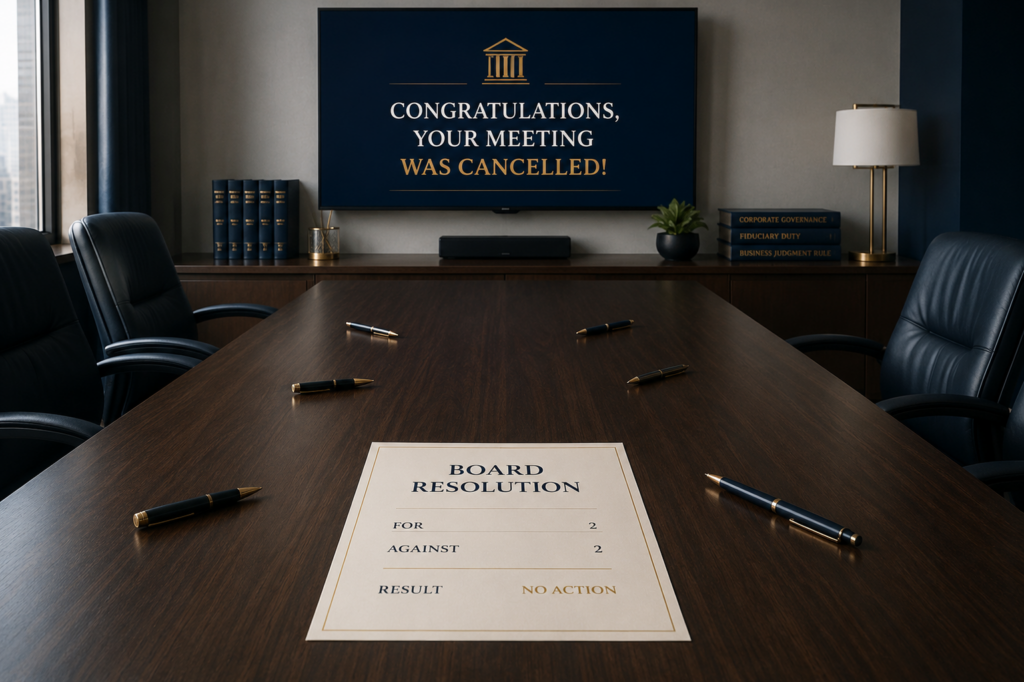
When directors cannot agree, the dispute can prevent the entire company from moving forward. Disagreement among directors is a normal part of corporate governance. Boards are expected to debate strategy, evaluate risk, and sometimes reach different conclusions about what is best for the company.
But there is a significant difference between disagreement and deadlock. A board deadlock occurs when directors are so evenly divided that the board cannot obtain the votes necessary to take corporate action. When that happens repeatedly, the consequences can extend far beyond an uncomfortable board meeting.
The corporation may be unable to approve financing, enter important transactions, appoint executives, authorize distributions, or make other decisions necessary to operate the business. In closely held corporations, board deadlock can eventually threaten the company’s future.
Voting Requirements Can Create Deadlock
The first question in evaluating a board deadlock is often deceptively simple: What vote is required? The answer may be found in the corporation’s bylaws, certificate of incorporation, shareholder agreement, applicable corporate law, or a combination of these authorities. Some decisions may require only a majority vote. Others may require heightened approval under the company’s governing documents.
Deadlock is particularly common when an even number of directors are divided into competing factions. A four-member board split 2–2, for example, may repeatedly be unable to authorize action. That makes the company’s governing documents critical to understanding both how the deadlock developed and how to resolve it.
The Bylaws May Provide a Path Forward
Corporate bylaws establish many of the rules governing how a board operates. They may address the number of directors, quorum requirements, voting procedures, vacancies, removal and replacement of directors, officer appointments, and other governance issues. When a deadlock develops, an interested party should view those provisions carefully before assuming litigation is the only solution.
The bylaws may contain mechanisms that allow the corporation or its shareholders to resolve the impasse. Conversely, the governing documents may reveal that neither faction has the authority to act unilaterally, which can become particularly important when one side attempts to move forward despite the deadlock.
Deadlock Can Prevent Important Transactions
The practical consequences of board deadlock can be substantial. Imagine that the corporation needs financing to expand its operations, but half of the directors oppose the proposed loan. Or the company receives an acquisition offer, but the board cannot obtain enough votes to approve the transaction.
The same problem can arise with major contracts, leases, capital expenditures, litigation strategy, distributions, and other significant corporate decisions. The company may have opportunities available, but without valid board authorization, it may be unable to pursue them. Over time, the inability to act can reduce the value of the business and damage relationships with lenders, investors, employees, customers, and other stakeholders.
Executive Appointments Can Become Part of the Dispute
Deadlock can become particularly disruptive when directors cannot agree about who should manage the company. A divided board may be unable to appoint or remove a chief executive officer, president, or other senior officer. Competing factions may also disagree about compensation, authority, or whether an executive should remain in office. This can create uncertainty throughout the organization. Employees may receive conflicting instructions. Executives may question who has authority to make decisions. Banks and counterparties may become uncertain about who can bind the corporation. What began as a disagreement among directors can quickly become an operational crisis.
Financing Can Be Especially Vulnerable
Corporate financing frequently requires board approval. A company facing a deadlocked board may therefore struggle to obtain loans, raise additional capital, refinance existing obligations, or approve guarantees and other financing arrangements. Timing can make these disputes especially serious. A corporation that needs financing within weeks may not have the luxury of allowing a board dispute to continue for months. If the deadlock threatens the company’s ability to meet its obligations or continue operating, the parties may need to consider more immediate legal or negotiated solutions.
Shareholders May Become Involved
Directors and shareholders occupy different roles within a corporation, but a board deadlock can eventually require shareholder involvement. Depending on the corporation’s governing documents and ownership structure, shareholders may be able to elect directors, remove directors under certain circumstances, fill vacancies, or otherwise influence the composition of the board.
But shareholder intervention does not always solve the problem. In closely held corporations, the same ownership divisions that produced the board deadlock may exist at the shareholder level. Two 50% shareholders, for example, may each control the election of an equal number of directors and be unable to agree on a tie-breaking mechanism. At that point, the dispute may become both a board deadlock and an ownership dispute.
When Does a Board Deadlock Lead to Litigation?
Litigation may become necessary when the parties cannot resolve the deadlock internally, and the inability to act is harming the corporation. A party may ask a court to determine whether particular corporate actions were valid, interpret the company’s governing documents, address alleged breaches of fiduciary duty, or provide other relief depending on the circumstances. Litigation can also arise when one faction attempts to circumvent the deadlock. For example, directors may dispute whether a meeting was properly called, whether a quorum existed, whether a particular director was properly removed, or whether a transaction received the votes necessary for approval. These disputes can turn corporate formalities into significant litigation issues.
Can a Deadlock Result in Dissolution?
In serious cases, yes. New York law provides circumstances under which a corporation may seek judicial dissolution based on director or shareholder deadlock. Whether dissolution is available depends on the corporation’s structure and the statutory requirements applicable to the particular situation. Dissolution is a significant remedy. It can result in the corporation being wound down rather than allowing one faction to prevail over the other. For that reason, the possibility of dissolution can substantially affect negotiations between the parties. A potential buyout, restructuring of board control, negotiated separation, or other resolution may become preferable to allowing the dispute to threaten the continued existence of the business.
Resolving the Deadlock Before It Destroys Value
A board deadlock is ultimately more than a disagreement between directors. It is a governance problem that can prevent the corporation from functioning. The earlier the parties understand their voting rights, governing documents, fiduciary obligations, and available remedies, the more options they may have for resolving the dispute before significant business value is lost.
At Alisme Law, we represent shareholders, directors, executives, and businesses in corporate litigation throughout New York. When disputes involve board deadlock, corporate control, fiduciary duties, shareholder rights, or corporate governance, we help our clients evaluate their legal position and develop a strategy designed to protect their interests and the value of the business.
Contact us to schedule a confidential case evaluation at 917-540-8432.
This article is for informational purposes only and does not constitute legal advice.